Wednesday, February 27, 2013

Supports from Educational Institution


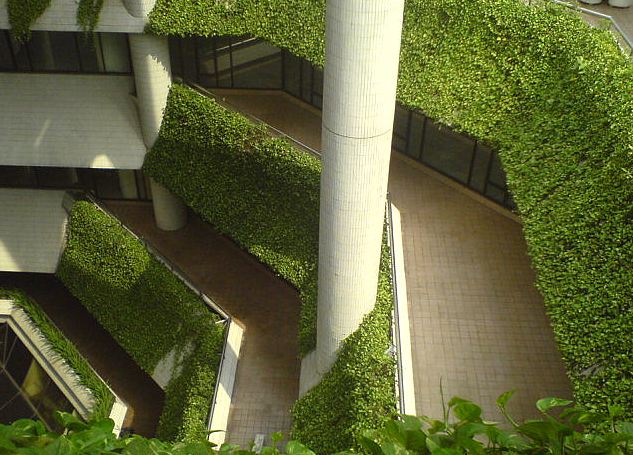
This time I will introduce Indonesia green movements that have brought educational institution to involve in sustainability.  According to this article from GBCI, in “the Declaration of Interdependence for Sustainable Future” in Chicago 1993, Indonesia has agreed to implement sustainability in every area.  I think I am late to know this…  However, the implementation was firstly done in one of the building construction project for Wisma Dharmala Sakti.  The building was done in 1988 and used Indonesian traditional architecture concept by Paul Rudolph (refer to this website and this website). 


Picture 1 Wisma Dharmala, Jakarta.  Photographed by: Melissa MD

            Furthermore, launched in 2010—University of Indonesia (UI) —UI Green Metric (refer to this link), has been used as a challenged to all universities world-wide to involve in the international ranking of green campus.  This is one of the implementation movements in Indonesia of applying ranking system to sustainability challenge.   By referring to the guidelines, the USGBC LEED and GBCI GREENSHIP system have been used as a basic of this ranking system.  


Picture 2 Criteria for UI Green Metric

This is interesting step to invite all universities which are the most fundamental knowledge center to involve in the green act.  


Picture 3 UI Green Metric logo
I think by following this system at least most people around the world who want to enter university internationally, know the university at the first sight.   As a matter of fact, to encourage the green university, UI has also implemented the green architecture and done in 2010 for a library building. (refer to this website).  

Picture 4 UI Green Library, Depok.  Photograph courtesy of Universitas Indonesia
             In addition, Indonesia has also opened a green school under Green School Community Association (GSCA), further information see this website. This is open to the public and is a collaborative idea to the sustainability.  This school located in Bali and encouraged by a nature-based school.  It incorporates not only the use of bamboo-based architecture from PT Bamboo Bandung but also green energy to its operational.  Again, it is interesting one of the school goals is to avoid Indonesian rain-forest depletion (more graphics can be accessed via this website and this website). 

   Picture 5 Green School, Bali.  Photographed by: Iwan Baan

Picture 6 Green School, Bali.  Photograph courtesy of PT. Bambu Bandung

 Picture 7 Green School, Bali.  Photographed by: Ahkamul Hakim
                            
Picture 8 Green School, Bali.  Photographed by: Iwan Baan

            Energy independence refers to the two systems of renewable energy that are coming from stand-alone photovolataics system and a vortex hydro generator.  These systems have been claimed to fulfill all energy needs in the school operational. 

Picture 9 Solar Photovoltaics, by: GSCA
                                 
Picture 10 Vortex-hydro generator, by: GSCA
                                                
            It is obvious that some people in Indonesia especially in the educational field have been trying to implement sustainability.  How about the industry, probably I need to further investigate the role of Industry in sustainability..


NB:  Green Act: 14.4 miles  = 0.475 gallons oil
        Cumulative 44.4 miles  = 1.465 gallons oil

Wednesday, February 13, 2013

Movements to Sustainability Implementation: Indonesia GBCI-Greenship , USGBC LEED and Green Globes


Many countries have tried to have their own green building standard which of course will bring the sustainability movements predictable.  I got my brand new knowledge when the time took course called High Performance Green Building in the University of Florida.  The course mainly explores and compares especially US Green Building Council (USGBC) Leadership in Energy and Environmental Design (LEED) certification system (further information about LEED can be seen at this website) and Green Globe certification system.  Green Globes was initially developed in Canada.  However, recently this rating system has been becoming collaborative works from both US and Canada. (Further information about Green Globes, please see this website).   


Picture 1 USGBC-LEED 

The final product of the course was the implementation of both certification systems into a case study for the existing building in the University of Florida (UF) campus.   It was a teamwork project.   Although it was a simulation, the experience of conducting certification process was challenging.  It was started with the interview with some users up to a rigorous decision making process for renovating the existing building case study.  The target was to gain a Silver rating for LEED and three globes for Green Globes.  It was achievable target!  Our team got 75 points out of 110 (we used LEED-NC for this purpose) and 790 out of 1000 achievable points for Green Globes.
                At the first time, we had a hard time to give the suggestion about the renovation.  I worked with my team to target the rating, i.e. Gold for LEED rating and three globes for Green Globes rating.  However, the final question of the simulation should be addressed to the real implementation which will of course collide with the “capital investment”.  We took a model of using photovoltaics system to the roofing system, and the result of the life-cycle cost was amazing, yet it was high cost-intensive project to implement.  We planned to do some retrofits in the Heating Ventilating and Air Conditioning (HVAC) systems that we assessed to be urgently required based on our interview.  In results, the total cost was huge.  Hence, despite the possible saving over the building entire life, the question remains has no answer.  Who will fund this project?  In the short few years—from the facts that UF has owned 50 green buildings inside the campus—I am sure most buildings in UF campus will become green buildings.   According to UF Green Building Program, the campus currently has own 1 Platinum, 16 Gold, 3 Silver, 8 Certified and 2 registered projects as well as 20 buildings registered under newer system LEED version 3. (Further information for UF Green Building Projects, please see this website).  This amazing achievement has shown the commitment to the sustainability of the University of Florida.
              In 2009, the year that I was firstly aware about sustainability, Indonesia developed a new certification system for Green Building named Greenship, under Green Building Council Indonesia (GBCI) and already registered as one member of World Green Building Council (WGBC).  I am sure this will lead to the Indonesian societies to be more sustainable in their infrastructure development programs.  For more additional information about the rating system, please access this website.  I think later it will be interesting to compare GBCI rating system to the existing green building rating system in the US.


Picture 2 Indonesia GBCI-Greenship


NB:  Green Act: 14.4 miles  = 0.475 gallons oil
        Cumulative 30.0 miles  = 0.990 gallons oil


Wednesday, January 30, 2013

When should we begin?

Can you convert this beautiful scene

   
Picture 1 Hess-Indonesia Ujung Pangkah Project, Information can be accessed through this website 
(Photograph Courtesy of PT Tripatra Engineers and Constructors)

into equally beautiful scene like this?


Picture 2 A 1.6 MW Denver International Airport Photovoltaics Farm 
 (Photograph Courtesy of Denver International Airport)

You have to wait until I sum up my ethical opinion due to previous blog I published…

In my opinion, the “only” reason behind sustainability is ethic.  However, one may perceive other reasons as sustainability foundation.  What I meant here is to keep trying to approach based on the proximity of perfection—theoretically.  It is hard to answer the explanation since people tend to struggle with their own interest and many conflicting interests behind it.  It is “politically” correct isn’t it? 
From a different viewpoint, the need of mediator—I emphasize to the role of government—is adequate to achieve win-win solution between two parties.  As the continuation from my previous introduction, the surrounding area near Lapindo remains stagnant.  There have been no solutions given to the affected societies.  From the contractor’s side, it has claimed to pay all losses—meanwhile they have approached the government to announce this riot as a national disaster.  Truthfully, the societies are still struggling to achieve their rights back.  At this point I will stop to further involve in a political atmosphere.  Nonetheless, I will define the damage types of this disaster.  The losses can be considered into two parts, i.e. both material and immaterial.  The measurement for material loss is clear.  Yet, the immaterial loss could be anything, for instances: the jobs availability, close-knit neighborhoods and a community structure.  The loss level has covered up to the entire county in that area.  Most importantly, one question may rise—how about the non-human ecosystem?  I bet no one can measure these losses and never can.  Extinction of a wide array of biodiversity…
Answering the starting question, solar is abundance in the equator area.  Indonesia positions on exactly the middle of equator.  It is convincing to harvest this infinite resource.  Photovoltaic has been widely known to accommodate direct energy conversion to electricity.  Given the same amount of money to produce, my individual opinion will stick on the renewable resource.  There will be no predetermined starting point to begin.  Neither am I nor other dedicated experts noted as newbie in the renewable energy.  In fact, this is an old idea.  Since the era of Edison, solar has been noticed as the “light” to the future energy.

Flashback:
Back in 1931—the year when Thomas Edison died—Edison told his friends Henry Ford and Harvey Firestone: “I’d put my money on the sun and solar energy. What a source of power! I hope we don’t have to wait until oil and coal run out before we tackle that.”
(Quoted from: website )

Hence, why should we wait to implement this? 

NB: Green Act: 14.4 miles  = 0.475 gallons oil
        Cumulative  15.6 miles  = 0.515 gallons oil


Monday, January 14, 2013

An Introduction


I was supposed to write down this at the first time I came to Gainesville (in late December 2009), the place where I began shifting my mind for my future career...  

"...to discover the future, you have to look at the past..." C.K. (1/9/2013 - 05.14 pm ET)

I knew that I have found my interest in Sustainable Construction since I had engaged in my first experience in construction –a small commercial building construction phase.  At that time, I hardly thought to find the effective design of a workshop building to optimize long-term benefits, to put on budget efficiency and to lessen environmental impact.  Although I have not been familiar with sustainability term, I had also found out that it was a part of sustainability concept that I had tried to get –the minimum effect to the environment as well as to the maintenance cost in the next future... 

Something had bugged my mind when I involved as field engineer in a big project for onshore construction of oil and gas plant, I realized that sustainability was the important key factor for every project related with construction activities. I was shocked by direct seeing ex-Lapindo project location during my onshore-break in Sidoarjo—East Java.  Disaster... yes... the local community and it local area had been affected by the impact of extreme hazard just because of unnecessarily construction miss-management.  The mud flood had unfortunately lifted up to the neighborhoods and its surrounding... This major impact had made a total downturn in the community life and of course the economic.  Surrounded by deep sorrow, I had been personally thinking that sustainable construction is absolutely required for engineer’s consideration within projects especially in projects in a country.  

Afterwards, recent worldwide environmental issues has made my self had strong alert that sustainable construction is a significant area of concern; not only to my specific interest in sustainability–focused  in energy management– but also to my country development that will have results in huge contribution for the knowledge internationally.  Recent tendency of sustainability issues must reinforce companies and governments in most country to have their particular standards fulfilled and complied to the international conventions: the term of energy saving policy, regulation for green house effect, and research for the alternative energy due to carbon amount restriction.  Innovations which are focused on these issues, indeed, will strengthen the main objective of sustainability. As consequences, my specific interest in energy management, not only should we know in how much the energy could be saved in every stage of project –from the initial appraisal, construction, adjustment, demolition stage– but also operation and maintenance will have significant correlation in determining amount of energy consumption. The whole activities both in construction and maintenance will significantly contribute to the basic knowledge in a sustainable design. 

Once again, albeit it is as a late start... in fact, it is just a new beginning towards sustainability (t.b. continued)

NB: today's green act: 1.2 miles of biking = 0.04 gallons oil saved.